
Breast Reconstruction
Rebuild the shape of your breast with beast reconstruction after a mastectomy or lumpectomy.
Dr. Marshall's Approach
If you’ve had a mastectomy or lumpectomy, you can choose to have surgery to rebuild the shape of your breast. Dr. Marshall offers breast reconstruction in Asheville and will work closely with your breast surgeon, oncologist, and radiation oncologist to coordinate the timing of your reconstructive surgery and ensure the best result. We also work with women who have had surgery in the past, or at a different facility.
The physical changes from breast cancer surgeries, even if they are not severe, can be harmful to a woman’s psychological well-being. Reconstructive surgery aims to cushion the emotional impact of this surgery by reversing some of the physical changes.

Dr. Marshall will explain the details of each surgery and recommend the method that will be best for your particular situation. Breast reconstruction can often be done at the same time as your mastectomy or lumpectomy. It can also be done later, either for your convenience or to accommodate chemotherapy and/or radiation therapy.
Insurance companies that cover breast cancer surgery are required to also cover breast reconstruction. This includes surgery to the unaffected breast to provide a symmetrical look. If you have any concerns about your insurance coverage, or about any aspect of breast reconstruction surgery, our team at Restore & Reveal Aesthetic Surgery in Asheville is here to help you through this process.
Breast Reconstruction After a Lumpectomy
If you’ve had a lumpectomy, Dr. Marshall can rearrange, or reconstruct, your remaining breast tissue to give your breast a more normal shape and size. Most women who have this relatively minor surgery go home the same day and feel back to normal after two to three weeks.
Breast Reconstruction After a Mastectomy
If you choose or need to have a mastectomy, you can have breast reconstruction at the same time as your mastectomy (“immediate reconstruction”) or months to years later (“delayed reconstruction”). There are pros and cons, in addition to personal preferences, when discussing “immediate” vs “delayed” reconstruction. Dr. Marshall will go over these in detail during your consultation.
The 2 basic types of reconstruction are “autologous” and “implant-based.”
Autologous Reconstruction
This breast reconstruction procedure uses your own tissue, skin and fat (and sometimes muscle) to recreate your breast. The two most common ways of performing autologous reconstruction are the DIEP flap and the latissimus flap. DIEP flap surgery is complex and only performed at large or university hospitals. It involves removing skin and fat from the belly region and using it to recreate the breast(s). Dr. Marshall does not perform these operations, but he is happy to refer you to someone/somewhere that does (Mission Hospital in Asheville). The latissimus flap surgery uses muscle, skin, and fat from a patient’s back to reconstruct the breast. This is sometimes performed in conjunction with an implant. Dr. Marshall does these surgeries at Haywood Regional Medical Center near Waynesville, NC.
Implant-based Reconstruction
This breast reconstruction procedure creates a breast mound/shape using an artificial silicone or saline breast implant. It oftentimes first uses a “tissue expander” to be placed at the time of mastectomy, or later if delayed reconstruction is needed or wanted. The tissue expander is filled with saline on a weekly basis until the breast skin is safely stretched out to a desired size (B, C, or D cup). Then, during another surgery, the expander is removed and a permanent saline or, most often, silicone implant is placed.
Breast Implant Placement
The implants can be placed on-top of the pectoralis (chest) muscle, a "subglandular" location, or underneath it, the "submuscular" position.
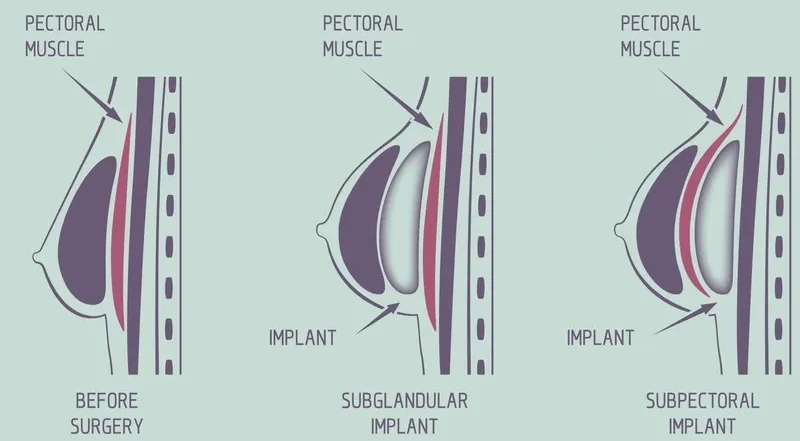
Subglandular and submuscular breast implants
Subglandular Implant Placement
Subglandular breast implants are placed on-top of the muscle and under the breast tissue. One of the advantages to this location is less pain after surgery and faster recovery. This means you'll be back to exercising 2-3 weeks sooner than if you have the implants placed under the muscle. Another advantage is that you avoid the possibility of developing what is called an "animation deformity"; this is visibly seeing the implants move under your muscle when those muscles are flexed. Dr. Marshall shows you videos of what this looks like during your consultation.
The main disadvantage of placing the implants in the subglandular position is the increase risk of capsular contracture. Capsular contracture was extremely common in the 1980s as the majority of breast implants were place in the subglandular position. This lead to plastic surgeons in the 1990s to start placing the implants in the submuscular plane. Dr. Marshall still utilizes the subglandular plane, and he takes steps during your surgery to reduce the incidence of capsular contracture that were not performed years ago. He will also encourage you to perform "breast implant displacement" exercises 1-2 times per day after surgery. After your mastectomy, you won’t have breast tissue under your skin to conceal the implant edges and/or implant rippling. So on top of the muscle placement can lead to greater implant visibility and rippling under the skin.
Submuscular/Subpectoral Implant Placement
Submuscular breast implants are placed under the chest, pectoralis muscles. This procedure involves 1-2 weeks more downtime and is associated with greater pain immediately after surgery. The greatest advantage of placing the implants in the submuscular position is the reduction in capsular contracture. While there is still a risk of it developing, those risks are lower when compared to subglandular positioning of the implants. Submuscular placement of the implants also provide another layer of coverage for the implant under the skin. For lean women or women with thin skin and breast tissue, the muscle may help conceal the implant from being visible thru the skin. This is especially true in the upper, inner part of the breast, the cleavage line.
The downsides of submuscular placement are the previously mentioned animation deformities, and sometimes the breast implants can shift down/lower over time. This occurs because the muscles are pushing the implants down each time they contract.
Breast Reconstruction Risks
In surgery, there are always risks and complications. Breast reconstruction complications are extremely rare. To minimize risks, patients should not smoke cigarettes, vape, and/or use nicotine. Eating healthy, exercising, and optimizing your nutrition with Vitamin C, Vitamin A, and Zinc sulfate are also essential to good healing.
The following are rare but can occur immediately following surgery:
- Bleeding
- Infection
- Incision separation ("dehiscence")
- Fluid collections
- Change to nipple sensation
Long-term, over months to years, the following are listed from most common to least common:
- Capsular contracture
- Implant visibility or rippling
- Implant malposition, ie "bottoming out"
- Implant rupture
- Breast Implant Illness (BII)
- Anaplastic Large Cell Lymphoma
Capsular Contraction
Of these long-term possibilities, capsular contraction is worth discussing in more detail. The "capsule" is your body's scar that forms around your implant. This is a natural process and it happens in every breast augmentation patient. Over time however, that scar (or capsule) can begin to squeeze ("contract") around the implant. There are 4 grades of contracture, with grade 1 being mild and not noticeable, and grade 4 being a deformed implant with pain. The exact cause of capsular contracture is unknown, but studies have shown the following help prevent it from occurring or decrease the severity:
- Submuscular placement of implants
- Antibiotic irrigation of implants
- Inframammary incisions
- Placing a protective barrier over the nipples/areolas during surgery
- Changing gloves prior to handling implants
- Only one person (the surgeon) touches the implants
Dr. Marshall utilizes all these practices to minimize your risk of developing capsular contracture. In addition, Dr. Marshall will discuss starting you on a new medication that has also been shown to decrease contracture, Singulair or montelukast sodium. This is a safe medicine that has been used for over 20 years to treat patients with asthma. It's taken once daily and has been shown to help prevent capsular contraction.
Breast Implant Illness (BII)
A relatively small subset of women with breast implants develop systemic symptoms such as fatigue, weakness, hair falling out, skin rashes, brain fog, and more. These symptoms can occur immediately following breast augmentation but can take years to present themselves. Treatment is often removal of the implants.
Breast Implant Associated ALCL
This relatively new but extremely rare (1 in 30,000) condition has been shown to be associated with only shaped, textured implants made from certain companies. Dr. Marshall's textured implants from Mentor have not been found to be associated with ALCL. ALCL is not breast cancer, but it is a cancer of the immune system.
Testimonials
I can not say enough good things about Dr. Marshall. I recently had breast cancer and he did my reconstruction surgery. I’m very pleased with the work he did but more than that he is a very kind and compassionate... Read full Google review
- Christy N.
My experience with breast implant removal at Restore and Reveal was great. Dr. Marshall is very thorough, explains things well, and very patient with questions! My pain levels were so low that I didn't need to... Read full Google review
- Lori M.